Sunday, June 10, 2012

Classic F-5 Mandolin

I built this F-5 based on the classic features of the traditional F-5 mandolins, with a stunning one-piece curly maple back, gold-plated tuners, ivoroid bindings and sunburst color.

 My original inlay design. This one has fixed twin carbon fiber bars in the neck instead of an adjustable truss rod.

 Rosewood heelcap, ivoroid/black/white binding around the on-piece back.

I inlaid a little scroll to fill the space at the end of the fretboard rather than installing half frets.

Quilted F-5


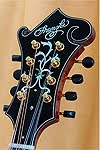
I built this one for myself using all the design elements I love. My original "flower pot" inlay design, the vintage-look tuners, "tortoise shell" binding and block fretboard inlays.

 
Trimmed with a strip of white and then a strip of tortoise binding.
My original block inlay design is made of four pieces of mother-of-pearl with an abalone diamond in the center and a thin strip of black fiber separating them.

 Finished in clear gloss lacquer

Monday, June 4, 2012

Square Peg in a Round Hole

 The dowel stick fits into the heel of the neck and extends to the back of the rim, pulling the neck tight and straight against the banjo rim. The original Orpheum was ornate in every way, including the dowel, so I matched the design of it with multiple pieces of maple, ebony and thin black fiber stripes. The laminated dowel also makes a stronger piece that is less likely to warp or twist over time.
 The end is carved and filed until it fits tight into the drilled hole. It is critical that it is perfectly straight with the center line of the neck.
It is dry fit without glue until I true it up with the banjo rim, then it will be glued in place.

Sunday, May 20, 2012

Restoring a c1907 Orpheum 5-String Banjo

The Orpheum is mostly all there. The neck is in excellent shape. I made a new fretboard and will have to match the inlays.


I found some excellent photos of an Orpheum #3 from the same era and copied the inlays. I hand-cut the abalone shell and routed the fretboard.

The peghead is in excellent shape and just needs one small piece of the inlay replaced.

Close up of the abalone inlay and the routed space in the fretboard.

the fretboard inlays in place and sanded flush.

Close up of the first fret I hand cut from abalone shell.

Sunday, May 6, 2012

Carving the Top for the Octave Mandolin

I made a chipboard template that use to trace a "topographic map" onto the solid spruce top wood. Each concentric line represents about 5/100" in height difference.
 
I have a router mounted on a large piece of plywood that rests on form holding the top or back plate. I can set the depth of the router and cut up to each line I have drawn.

The lowest area is cut first. I then raise the router and cut the next ring for 11 different levels.

After all the rings have been cut, it looks like this.

Then I use thumb plane to carve the top plate and blend together the different levels. Then lots of scraping and sanding to get it to the final outside shape.

F- Style Octave Mandolin Prototype

This is my first Octave Mandolin build. Like a mandolin, but much larger and tuned an octave lower. There is no standard size, and no real plans to go by, so I'm developing a prototype based on my personal preference for fret scale and body size. I am drawing detailed plans as I go and making modifications as I go. I made a form for the body and steam bent the maple for the rims. The head block is solid maple and the end block and two point blocks are made from maple and mahogany.

The rims are glued to the blocks and the has taken shape.

 The neck has been cut to rough shape with the ebony headplate and adjustable truss rod installed. The rosewood fretboard has been laid out and fretted to a 20.875" scale, making it easier to play for small to medium hands.

My original "flower pot" design for the peghead inlay. I hand cut the pieces from mother-of-pearl and abalone.

Saturday, April 21, 2012

Color Added

 I have applied the stains to the two F-5s. #12011 with quilted maple back and sides and "tortoise" bindings.

 The front of #12011 showing the special block inlays

 #12012 is very traditional, but I felt it needed a little flair at the bottom of the fretboard.

 Traditional ivoroid bindings, and rosewood heelcap.

 This one also has a very nice one-piece curly maple back that I had been saving for a few years.

I matched the back with a neck that had a very similar flame pattern so the stripes would carry through from top to bottom.