Saturday, February 1, 2014

Dog Boys


I love when I get a chance to do something a little different. The client, from Nova Scotia, ordered two mandolins, an A-5 and an A-4. He wanted the designs to pay tribute to his two dogs and to Canada. One of the dogs was a Scottie, the other a mix breed.


The quilted maple backs for both mandolins came from the same piece of wood.


I cut out the tiny scotties by hand. I decided to add three more, so I had to cut two more even smaller


For the A-4, I decided to use paw prints rather than try and I wanted them to wlak up the fretboard instead of centered. Each little paw print is made of 5 separate pieces of hand-cut mother-of-pearl. 45 tiny pieces. I cut several more because I knew I would drop a few, never to be found. Surprisingly I only dropped two, and I found one of them. 


Unfinished, strung up to test the feel and make any adjustments.


The dovetail neck joint.


The guts.


A Canadian maple leaf, cut from abalone. I love these Golden Era tuning machines from Stewart MacDonald. Relic brass finish with black knobs.


A pack of  wild dogs 

Sunday, October 13, 2013

1927 Gibson RB-3 Partial Restoration


This is what it looked like when it showed up at the shop. All (or about 98%) original 1927 Gibson RB-3,
5-string banjo. Not a tenor conversion. The real deal! A client is having me prepare it for sale. More to the story at the bottom of this post.


Kinda dirty, some tarnished metal, but in excellent shape otherwise. I'll give it a complete cleaning to remove the grime but not re-finish or replace any parts other than the head.


And by "kinda dirty", I mean filthy-wash-hands-every-20 minutes-disgustingly dirty.


It had 70's era cam-style tuners that left an impression in the headstock.


Some grunge around the 5th string tuner, but the binding is still in great shape


The resonator is pretty rough. I don't want to try and refinish it. It was well-played and shows its age naturally.


The back of the headstock has some residue from the cam tuners, but it's on the surface and I think I can get it off without going into the finish.


These look to be the original Grover tuners. Dirty, but seem to function properly.


Every part of the banjo, every screw, washer and nut has been removed. I hope I remember how it goes together.


The metal cleaned up very well, the fretboard and inlays look great.


The tension hoop had worn through the nickel plating in one area, but the tailpiece is in excellent shape.


"Under the hood."


The wood rim has no cracks or flaws other than cosmetic. The rim rods and nuts polished up nicely.


The tuners are discolored from age, but not nearly as grungy as before. The cam tuners left a dull spot, but it's not bad.


The RB-3 in 1927 was not the fanciest banjo in the Mastertone line, but I really like the simple elegance.


The "Rest of the Story" as they say:
This banjo was owned by Ralph Stanley until 1963, when it was sold to Buster Jenkins, a fiddle player from Kansas. Buster passed away around 2008, and my client acquired it from his estate. This banjo has all the mojo of a genuine pre-war Mastertone, plays and sounds like a dream. It's got the archtop vibe that brings out the Ralph Stanley and Doug Dillard in everything you play, and is crystal clear all the way up the fretboard with just enough low end to make you feel every note in your gut. This banjo is bonafide!

Tuesday, June 18, 2013

Vine Inlaid Walnut Banjo

I printed the design on a laser printer and cut it out with an X-Acto and glued it to the peghead. This gives me a very clear line to rout to.

The paper comes off easily with a little warm water. Then I go around and rout any areas that need it to get the mother-of-pearl to fit.

The logo is difficult to cut, the pearl is so brittle. After breaking a few in the beginning, I now know which cuts to make first, and I rarely break a piece.

 
The first of the vine pieces are cut out. I cut some of the pieces in one or two sittings, then come back to it later. It's a lot of cutting with a jeweler's saw.

 The fingerboard is routed using the same technique as above.

 The fretboard completely inlaid!

The "business end" of the banjo. Walnut block rim with maple bottom trim. Archtop tone ring and custom 24-piece nickel-plated flange plates I designed and had machined for me.

 Banjo complete. Over 70 individual pieces of mother-of-pearl all hand cut and inlaid.

 I developed the design for the vine over a long period of time, drawing and re-drawing. I wanted it to look organic and free-flowing, but at the same time, make it tie into the key fret positions where the dots would normally be. Rather than put very obvious markings on the key frets, I designed it to have a little more mass at the 7th, 10th, 12th, 15th, 17th and 19th frets.
 Full view.

 The back of the burl walnut resonator with the checkerboard purfling rings.

 The checkerboard design carries over to the sides of the resonator and the neck binding.

The walnut/maple rim and the 3-piece walnut/maple/walnut neck and maple/ebony heelcap. A closer look at my flange design incorporating elements of the classic Gibson and Vega flanges.

Tuesday, January 1, 2013

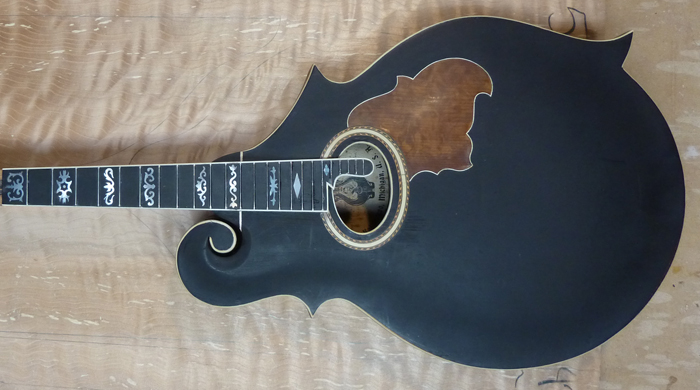
1906 Gibson F-2 Assembled and Varnished

Before and after. Ready for hardware and strings
Crack repaired and top sanded
Black top touched up ready for varnish.

Applying the shellac varnish

Varnished

Varnish applied to the back

Shiny new peghead

Front and back


Saturday, December 8, 2012

 A nice piece of solid Honduras Mahogany just like the original.

 Unlike the original, I cut 2 grooves into the neck block on the table saw and inserted carbon fiber bars to add stiffness to the neck. The original just had the rosewood center strip, but I like the stiffness the carbon fiber adds because it helps increase the sustain of the strings when they are strummed.

 Cutting the scroll on the headstock is a difficult thing. It can get away from you quite easily. Orville Gibson designed this over 100 years ago, and it's still being imitated. He designed it so the vertical cuts are perpendicular to the fretboard surface, not the headstock. To make the cut, the neck is held in a jig while it is cut on a bandsaw with a 1/8" blade.

.
The neck is held in the same jig as it is smoothed out on a spindle sander.
 
After cutting the Mother-of-Pearl logo, the headstock is routed out using a Dremel rotary tool and very fine bits.